
Twist & Shout:
On the Troubling Vision of Francis Bacon

I.
He has been celebrated as one of the greatest figurative painters of the 20th Century and for some, in all of art history. But Francis Bacon often noted, with a tone of devilish pride, that he could not draw. I’m not sure his claim is an admissible one. His portraits, as twisted and distorted as they are, harbor an uncanny likeness to their subjects. But the painter said it’s just all about looking. No: you have to draw well to achieve this.
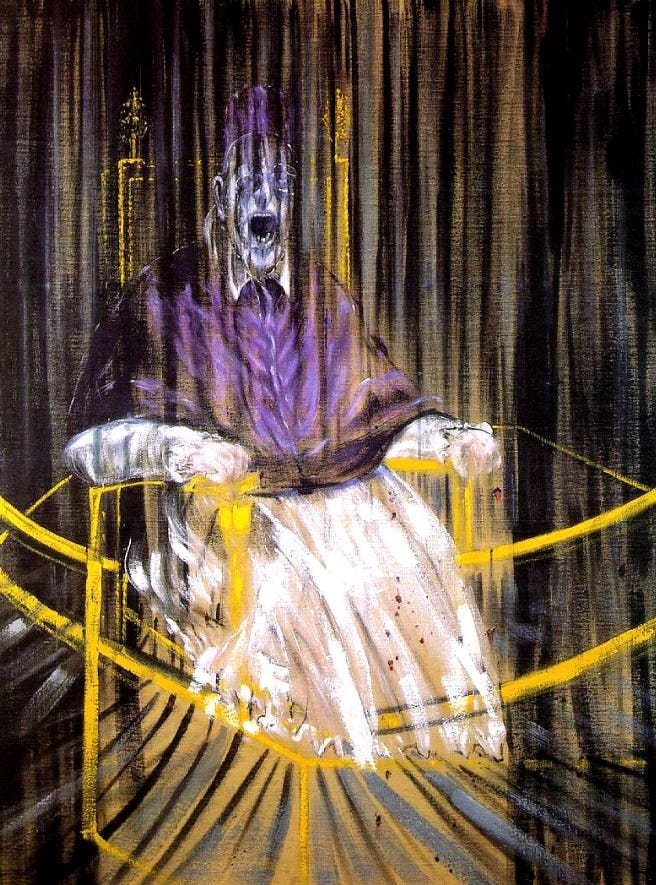
Francis Bacon cited the Old Masters as his guide and inspiration. Yet he rarely if ever painted from live models like they did, and preferred instead to work from photographic images (often blurry) torn crudely from newspapers, posters, or magazines and, remarkably, medical journals. Bacon’s iconic portrait of the screaming Pope (above) was inspired by a tattered photograph of a painting of Innocent X by Diego Velasquez ( 1599-1660). There is no evidence that Bacon ever saw Velasquez’s actual painting even though he had multiple opportunities in his long life to do so. Indeed, on one occasion he confessed some anxiety about seeing it in person when he happened to be in the painting’s neighborhood. This behavior is rather strange. If you love these Old Masters so much, and in particular Velasquez - the inspiration for your most iconic works - why avoid the opportunity to put your nose right up against the real thing?
The answer may be that the painter seemed most comfortable at a remove from his subjects, able, as he once put it, to “practice my violence on them” alone in the strict privacy of the studio. For Bacon, the content and unmistakable (and irreplicable) style of his work appears to have just spun out of his untrained head, stimulated, as he claimed, by the chaotic photographic detritus littering his studio floor. Old Masters never did anything analogous to this practice nor could we imagine them describing what they do as “practicing violence.” In this, Bacon’s vision seems thoroughly modern, as were his sloppy studio practices and, to an alarming degree, his careless use of materials (ask the restorers). As a modernist, it seems he embraced the modernist canon to shock. But not so fast. In many ways, the Old Master citing may be warranted.
In addition to Velasquez, Bacon adored Rembrandt and Titian (their late works), Ingre, Massacio, Poussin, Michelangelo; and “newer” Masters like Manet, Degas, and Van Gogh. Like Picasso, Bacon eschewed abstraction. He held a particular contempt for the works of Jackson Pollock and deep ambivalence about the Pop Art of Andy Warhol. Perhaps at some insecure moment in his early career, Bacon found himself alone outside any “ism’s” the art world tried to impose on him. Critics sometimes tried to place him with the Surrealists, the Neo-Expressionists, and Neo-Romantics, or mocked his work as mere Grand Guignol theatre put on canvas. The painter resisted convenient categories. So, why not find shelter with those painters of incontestable genius in the Western canon? Picasso at times tried the very same thing. It’s a way of throwing critics off the trail.
In a century of horrifying violence, Bacon sought to unmask the modern world in the only way he knew how, and for this we can give him Goya as his true progenitor. If, following the Holocaust, Hiroshima, Dresden, Stalingrad, Nanking one had had the opportunity to ask Francis Bacon: “Who of all the Old Masters if alive today would most likely be painting like you?” the answer would have to be Goya. Bacon’s aim was to “locate the inexpressible by going too far.” Beneath the mask of appearances was the nightmare he sought to bring forth just as Goya struggled mightily to do the same from the atrocities of the Napoleonic Wars. Aghast at the carnage of WWII, the public was perhaps ready at last to look into this terrible mirror. Careful drawing wouldn’t help here; the tidy ordering of things on a canvas, tight finishes, restrained color and reality itself had to be ruthlessly violated to reveal something deeper, or so he (and we) thought, and the violations began in earnest midcentury in the his famously disordered studio in London.
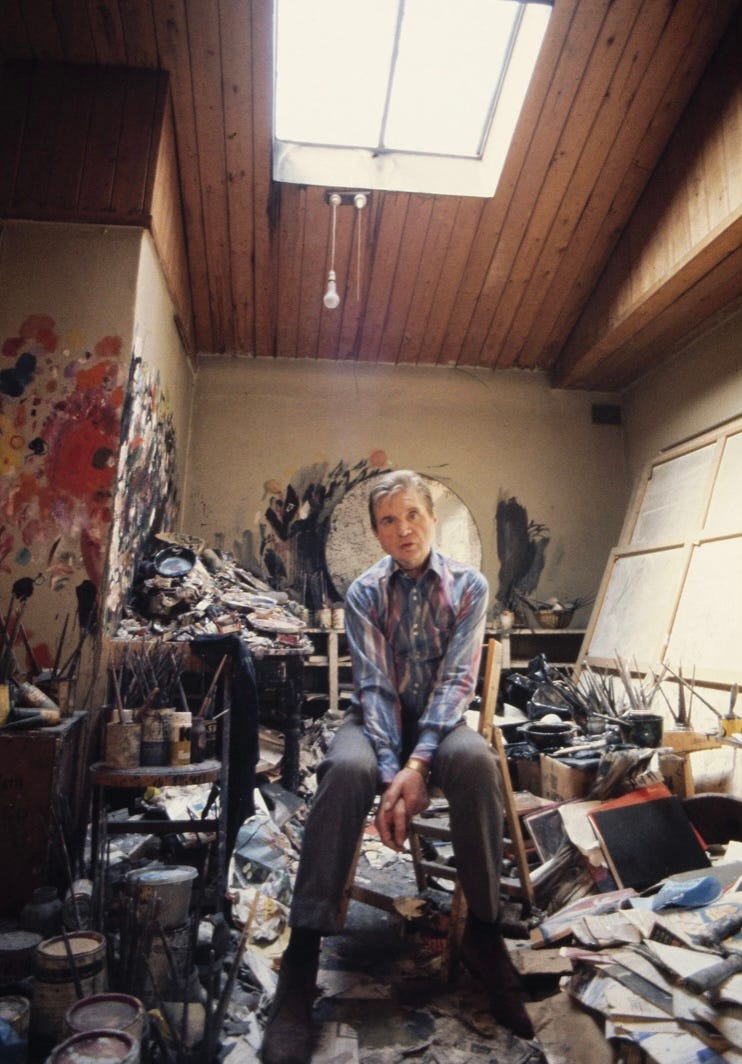
Francis Bacon in His Studio, 1974.
II.
He was born in 1909 to an aristocratic family on an estate in Ireland. Bacon’s father, Edward (Eddy), who everyone called “The Major,” was what we would now call “a man’s man” - fond of hunting, gambling, rigorous outdoor activity, etc., a stereotype of the landed British upper class male. He owned and raced horses. Predictably, The Major developed a dim view his son’s “weak” nature plagued as it was by severe chronic asthma. Eventually, his father’s awareness of Francis’ homosexuality would irreparably separate them (The Major whipped Bacon as a boy when he caught him trying on his mother’s underclothes). Francis was sent away to relatives in England when he was 16. He lacked formal education; he was provided private tutors.
Francis Bacon was distanced from his mother, who seemed unable to form any coherent picture of her son. Bacon and his sister however, maintained a close friendship throughout the painter’s life. Francis was also close to his grandmother, a favorite aunt, and a nanny who took care of him way into Francis’ adult life. The love of women probably saved Bacon from being crushed by his father’s toxic masculinity and homophobia, and his mother’s emotional distance. As he grew, Francis Bacon became increasingly surrounded by nurturing females, all very colorful and intelligent figures, many of whom became muses and models in his work, others serving as personal aids and gallery owners who became indispensable to his career. He was also attracted and attached to working class people while still at home in England’s complex aristocracy and elite literary circles. His upper-class manners and erudition never got in the way of his facility in cruising the docks or the underground pubs of Soho. His psychological shape-shifting is part of his enduring allure as an art world celebrity. Shape-shifting would be a good way to characterize the forms emerging on his canvases.
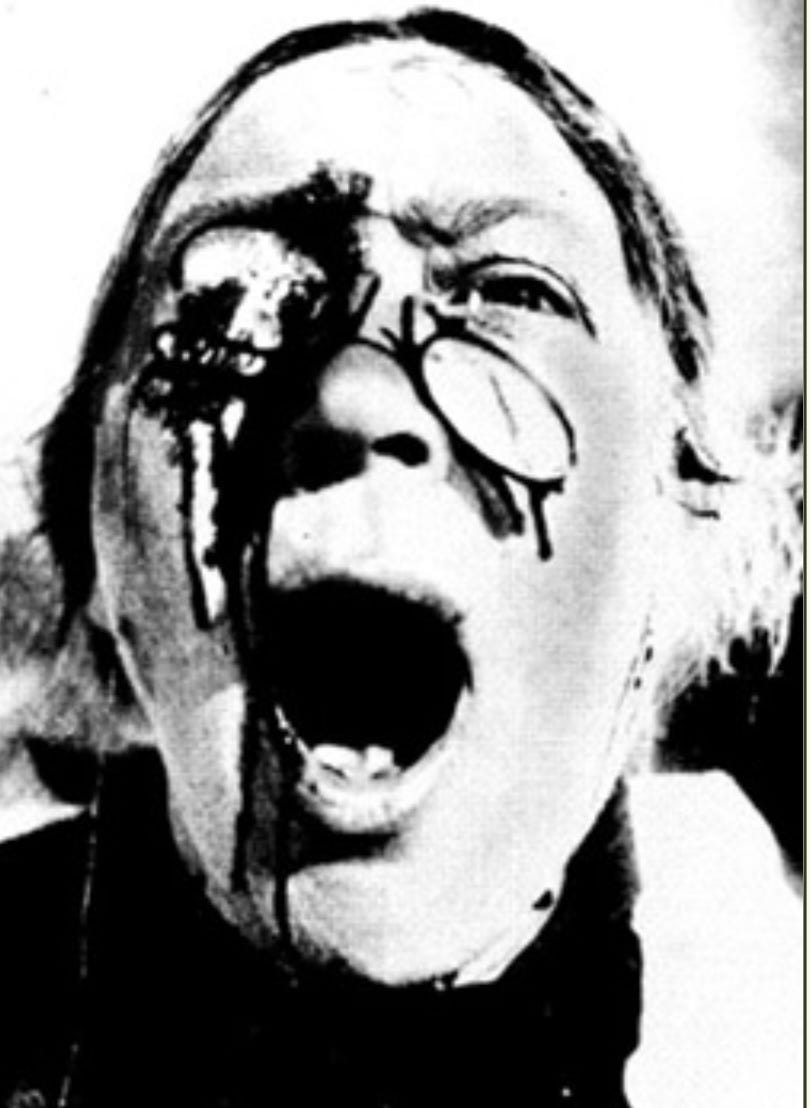
In the 1920’s, Bacon’s family was affected by the Irish “Troubles” (they were stalked by the IRA) and the whole family migrated to England. The Major continued to gamble and strut. As a young man, Francis escaped to Paris and Berlin with a brutish cousin who showed Francis the seedier side of the great capitals. It was in Berlin where Bacon first saw the Sergei Eisenstein film, “Battleship Potemkin.” An image from the film of a screaming nurse stuck in his head and would inform many future paintings, particularly his series of screaming popes. It was a silent film thus the scream was silent, and thereby all the more unsettling.
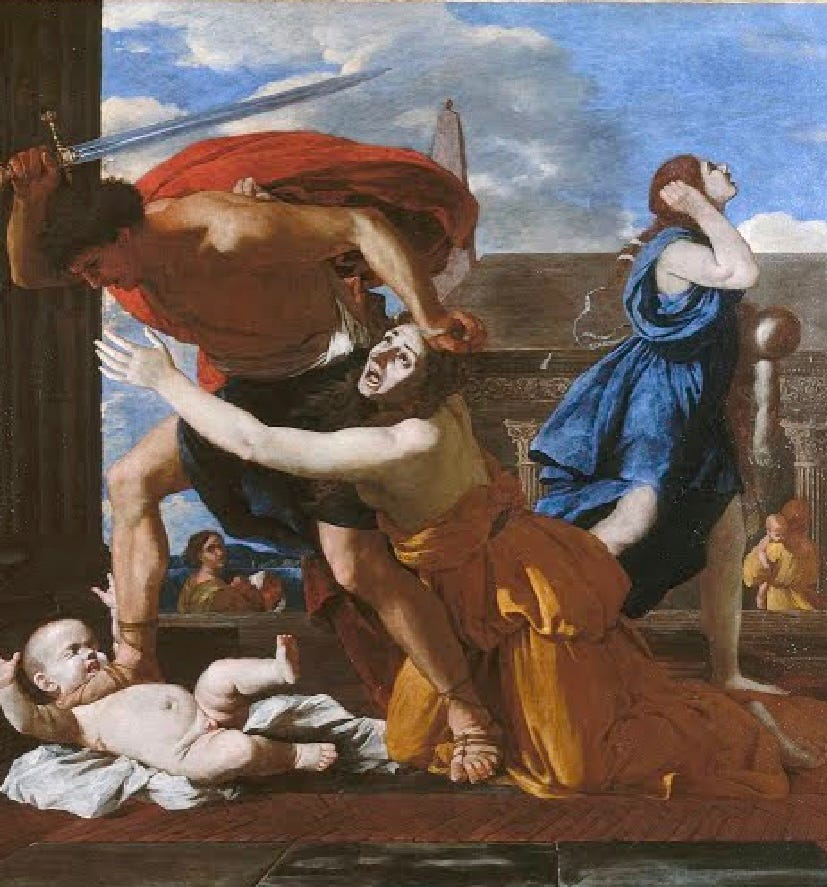
Bacon later returned to France by himself, was befriended by a French family in Chantilly, and learned the French language there. It was in Chantilly that Bacon first encountered Poussin’s “Massacre of the Innocents,” and he claimed its portrayal of violence, particularly portrayed in the face of the screaming woman, affected him deeply. The two images - Eisenstein’s and Poussin’s - are the footings in Bacon’s oeuvre.
Leaving Chantilly, Bacon hung out in Montmartre during its artistic and literary heyday in the late 1920s (though he never crossed paths with Picasso). At the time, Bacon was preoccupied with modern furniture design and returned to London and tried his hand at it, unsuccessfully. He had been thinking about becoming a painter. Picasso loomed large in the international art world. While he didn’t ever meet Picasso, Bacon was impressed by a 1927 Picasso show at the Paul Rosenberg Gallery in Paris. In the 1930s, Bacon was back in London. He began painting but destroyed most of his work from this period (it’s rumored he destroyed over 700 paintings).
There are many vivid descriptions of Bacon’s wild private life - the frequent switching of studios and residences, his participation in the homosexual rough trade, the seedy yet convivial clubs where he hung out in Soho, the interminable parties, gambling, debauchery and heavy drinking. Ever the gentleman, Francis invariably bought drinks for any room he was in and unfailingly picked up dinner tabs. His biographers paint a picture of a vibrant, complex personality: of impeccable manners; a gracious host; elegant attire; an unquenchable thirst for fine champagne and wine; a deep appreciation for excellent food. Yet we are given the simultaneous image of a man fond of leather jackets and tight pants, rough sex - anonymous and otherwise - drawn to the back alleys, the sailors and stevedores; chaotic rows with alcohol-soaked lovers. The debauchery went on relentlessly until his death at age 83. But he was always up everyday at 6am, ready to paint until noon, then it was off again to carouse. It seems he was impervious to hangovers.
Not withstanding his strained childhood, the origin of Bacon’s art - and perhaps his endemic devil-may-care debauchery - can be traced to his experiences in London during the Blitz in World War II. His asthma prevented his service in the military but he willingly volunteered as an ambulance driver during the horrific German bombing of the city. He was a close observer of burned and crushed bodies pulled from the rubble. At night he joined with his coterie of pub-crawlers in the sleepless blackouts drinking in his favorite haunts, anxiously waiting for some random bomb to eviscerate the bar or apartment building. A deep thinker, he embraced Nietzsche then as his philosopher; Aeschylus as his poetic, Dionysian narrator of the human scene; and atheism as his moral conviction. Humans as raw meat became an unavoidable vision, and he put this to paint, most vividly in his enormous post-war masterpiece now in the New York’s Museum of Modern Art. He said at the time: “Every time I go to the butcher, I think how extraordinary it is that I am not in place of the animal.”
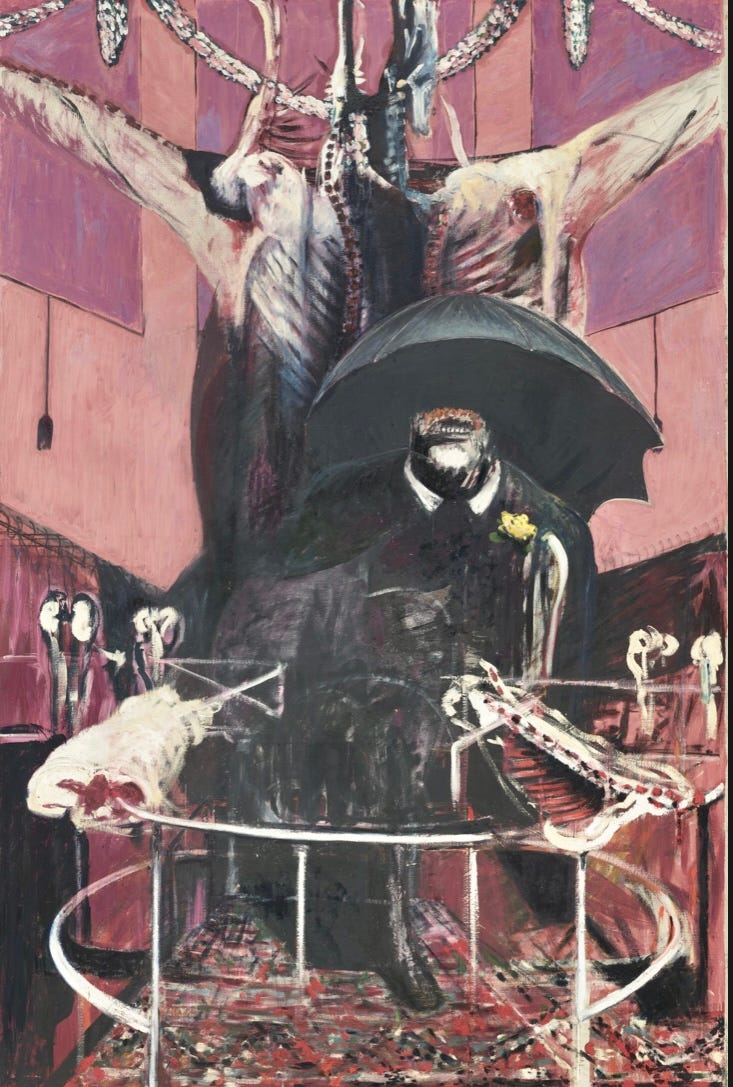
Francis Bacon, “Painting, 1946.” Oil and Pastel on Linen, 78” x 52.”
The breakthrough painting of his career was the earlier “Study For Three Figures At The Base of A Crucifixion,” executed in 1944. By then, the war was raging and public knowledge of the Death Camps was becoming more widespread. When the painting was exhibited, it shocked and flummoxed its audience. It created what we would now call a “buzz.” Reviews ranged from shock, incredulousness, and, of course, dismissal. The painting didn’t sell. His eminence of British painting, Kenneth Clark, Director of the National Gallery, found it “interesting,” thus damning it by faint praise but, ever attuned to an emerging art phenom and encouraged by the leading painter of the day and Bacon’s friend, Graham Sutherland, Clark left the door slightly ajar.
The painting is derivative of Picasso’s pleasant seashore biomorphs from the late 30’s.
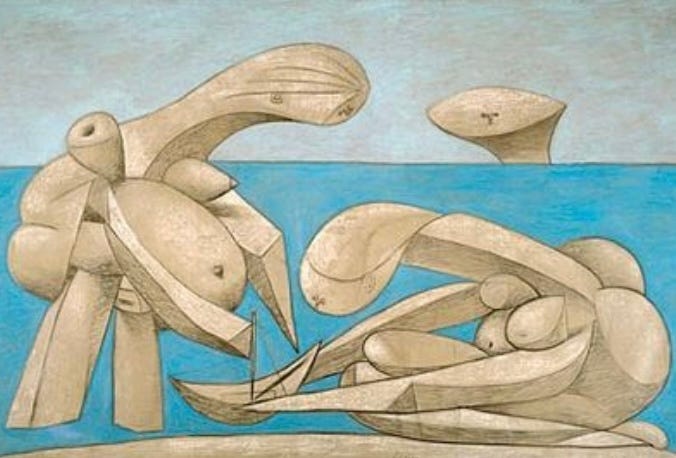
Pablo Picasso, “On The Beach,” 1937
Bacon took this motif and flooded the background with a lurid orange pigment. The triptych’s images, unlike Picasso’s benign forms, assault the onlooker rather than beguile. Bacon gives us beasts twisting and contorting, coming in for a kill. Bacon is unmasking Picasso’s bathers in a way, and showing us their inner savagery, the core violence of humans.
This painting set the stage for all of Bacon’s subsequent work, including his frequent use of the triptych format. Like a car accidents, one cannot look away from the paintings of Francis Bacon. They convey a view of modern life conducted in an abattoir. He noted once “the beauty of blood,” and concluded that “a thing has to arrive at the stage of deformity before I can find it beautiful.” If you love the work of Francis Bacon, it requires your collusion in this dark and disturbing sensibility.
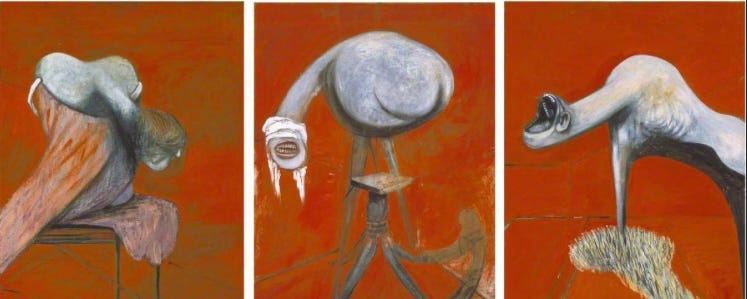
Francis Bacon, “Study For Three Figures At The Base of a Crucifixion.” Oil and Pastel on Fibre Board.” 1944.
III.
Peel back the onion of Francis Bacon’s many tangled affairs and you find two men at its core: Peter Lacy and George Dyer. While Bacon avoided the use of the word “love” in describing his relationships with men, these two stand in for love’s most authentic meaning in the painter’s complex interior life. Both relationships were tempestuous, and each resulted in suicide leaving the painter devastated.
Peter Lacy was a strikingly handsome, ex-Royal Air Force pilot, a veteran of the Battle For Britain, and a homosexual that Bacon met in 1952. Lacy was also an alcoholic and a sadist with an explosive temper. The more abusive Lacy was to Bacon, the more Bacon seemed to love him. They lived together for several years, most notably in Tangiers. On-and-off separations involved Bacon’s frequent travels from London to Tangiers to see his lover. It rarely went well. Once, in a fit of alcohol-fueled rage, Lacy threw Bacon through a plate glass window requiring the painter to have is eyeball shoved back into its socket and stitched up. They went on like this.
Tragically, Lacy killed himself with alcohol and drugs three days before Bacon was to have his first major retrospective at The Tate Gallery in 1962. After the show, addled by profound grief and anger, Bacon impulsively destroyed several paintings in his studio and gave others to a fellow artist who was told to reuse the canvases (luckily he didn’t). A painting of Lacy by Bacon eerily captures the roiling savagery hovering just below the surface; Lacy appears poised to spring off the couch at any moment and, indeed, throw you through a window or kick you in the teeth. Interestingly, Bacon’s reaction to Lacy’s death was to destroy works. His reaction to Dyer’s was the polar opposite.
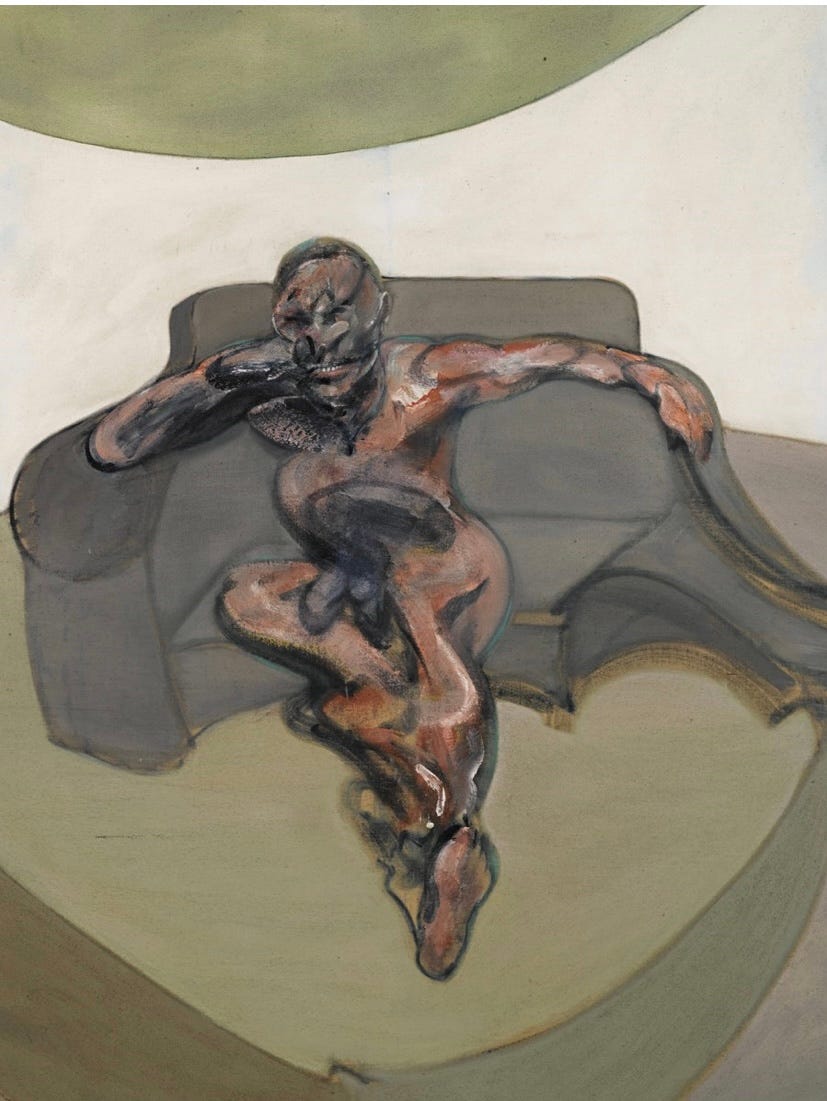
Francis Bacon, “Portrait.” 1962.
George Dyer was not a violent man by the Lacy standard, but he was a tough guy. His relationship with Bacon would be punctuated with drunken rows, screaming, slamming doors, storming off, etc. Dyer was much younger than Bacon. Dyer was a petty thief from the East End docks of London, an unwashed cockney with a beautiful body. Bacon had been attracted to this type many times before, but for Bacon, Dyer’s special attraction was perhaps the opportunity to introduce a younger man to the finer things in life - like a favorite uncle.The relationship however would become suffused with conflict, resentments, and betrayals. It ended tragically with Dyer’s overdose of drugs and alcohol in a Parisian Hotel in 1973 on the very night of Bacon’s apotheosis as a painter: a gigantic retrospective at the glorious Grand Palais attended by a vast crowd made up of European royalty, literati, French officials, and the art world’s wealthiest and most knowledgable connoisseurs.
Bacon hid his grief well for the festivities - charming as ever - but he took out his grief back in the studio in series of heart rendering triptychs, sometimes called The Dark Triptychs, commemorating Dyer’s death and his turbulent relationship with the painter. I, and many others, find these works simply exquisite for what they convey about someone’s longings for a fallen lover, the disgraceful and pitiful circumstances of Dyer’s end. They are an expression of an interior grief beyond measurement. I post two of them here:
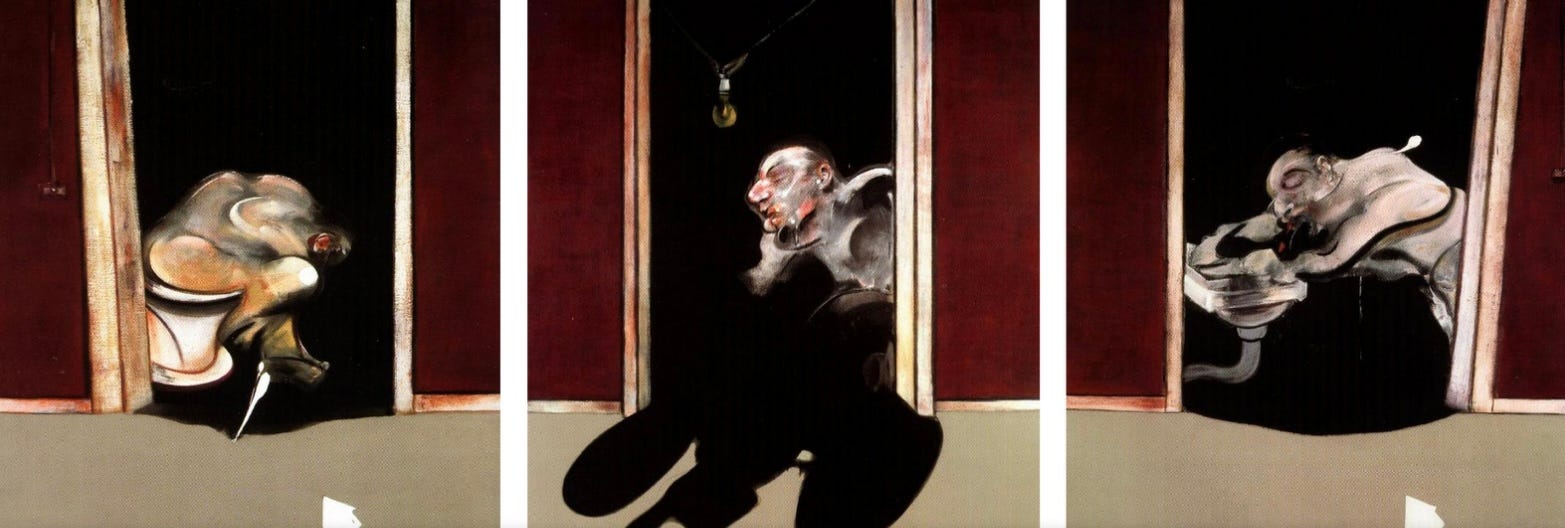
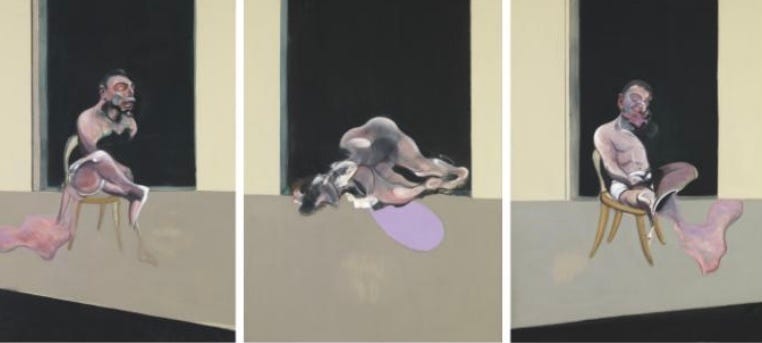
There was a third major male figure in Bacon’s life, but they weren’t lovers. Lucien Freud (Sigmund’s grandson) was a British painter of equal stature to Bacon. Freud, like Bacon, rejected abstraction in favor of figurative painting. But if Bacon’s progenitor was Goya, Freud’s was clearly Rembrandt.
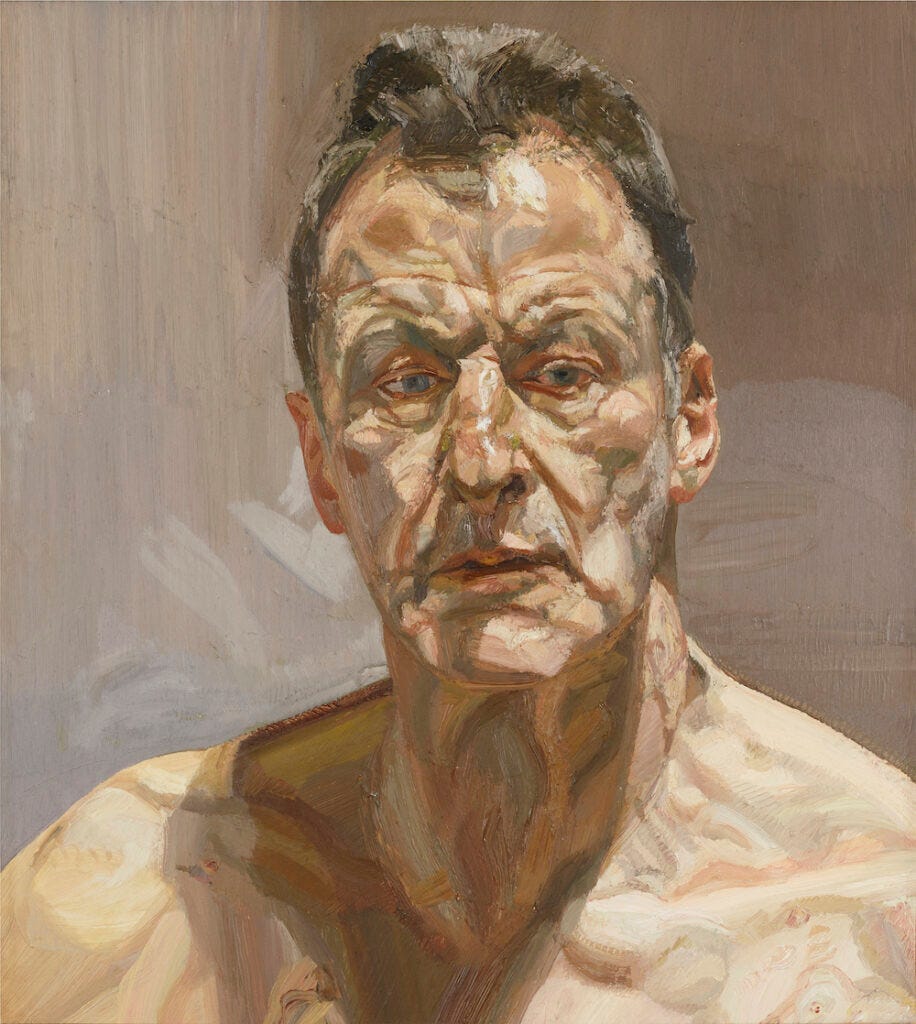
Lucien Freud, “Reflection (Self-Portrait),” 1985.
Freud was heterosexual and a notorious womanizer. Nonetheless, Freud and Bacon were unusually close and Freud was always comfortable in the scrum of gay admirers and the tough revelers who habitually swarmed Bacon at his infamous hangout, The Colony in Soho. Bacon and Freud drank together and exhibited together. Their friendship was genuine and long. With Freud, Bacon could talk shop, which they did often and intensively. Sadly, professional rivalries eventually pushed them apart in the 1980s; they ended up refusing to speak to one another, and neither ever really clarified why this had become so.
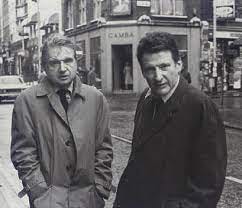
Bacon & Freud in London’s Soho, 1974
In a happier time (1969), Bacon painted his friend in a famous triptych, a painting whose sale in 2013 would shock the art world (it sold for $142 million). Buyer: Elaine Wynn. She has good taste. And money.
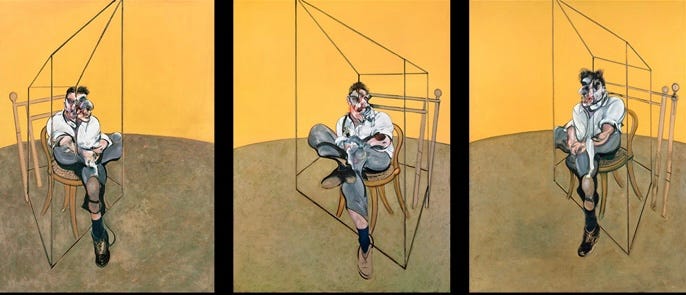
Francis Bacon, “Three Studies of Lucien Freud,” Oil on Canvas, 78” x 58”. 1969.
As someone devoted to the classical realism tradition, I have always found myself struggling in my thoughts about Francis Bacon’s paintings, the same way I do with Van Gogh. With Bacon: Why all the distortion? With Van Gogh: What’s with all that garish color? As a painter, I don’t admire Bacon’s impulsive, untrained use of materials that have now created in his legacy problems of conservation. I do admire the discipline of his compositions, even the caging of his subjects in those transparent boxes - something must hold in those whirling dervishes. It also must be said, and has been said often, that his paint handling on the canvas was deft and loaded with flourish. Despite its dark content, it’s always intriguing and fun to look at his work. These disturbing paintings strangely entertain and hold your interest.
What I most admire is Bacon’s fearlessness in expressing strong emotion, to forever reach deep, his attempt to get us to feel something, too. Francis Bacon is far from an arid Kantian modernist painter, striving to present us something we can react to with a cool “disinterested interest” (something I invariably experience with Picasso). There’s no irony here either (unlike Damien Hirst or Warhol). No, Bacon dove right into the deep end of the pool. And given what was lurking there under the surface, that took courage.
REFERENCES
Mark Stevens & Annalyn Swan, Revelations, Knopf. 2021.
Michael Peppiatt, Francis Bacon: Anatomy of an Enigma. Farr, Straus & Giroux. 1997.
Martin Harrison & Christopher Bucklow, Inside Francis Bacon. Thames & Hudson, 2020.
Seipel, Vitali, & Steffen (eds), Francis Bacon and The Tradition of Art. Skira. 2004.
These essays on art, artists and their times are amazing. I knew much more about the 17th century statesman and philosopher Francis Bacon than the artist Francis Bacon. There are threads between the two that are interesting. The earlier FB challenged the conventions of science in his day, arguing for an empirical approach. Although he was a religious person, the first FB believed the existence of God could only be studied through arguments for his existence. Any other evidence, according to the first Bacon, was due only to divine revelation. And, the earlier FB also struggled with his sexuality. While he married, it’s likely that he was at least bisexual. I love the connections we see through history. Thanks for giving me this one.
Keith, the article about Francis Bacon was thought provoking. The top painting resembled a cleric I may have seen before. Somewhat eerie but maybe truthful. Thank you.